Cover Crop Species
Summer planting for fall grazing. Plant warm-season cereal grains such as sorghum sudan and pearl millet after harvesting winter grains.
If planting is delayed until after mid-August, plant oats and peas. The yield will be lower for the oats, but because warm-season grains tend to be lower in digestibility, the forage quality of the oats will be higher than that of the sorghum sudan or millet. After a frost, cool-season cereals like oats and barley wilt and discolor, but the forage retains its quality.
Fall planting for spring grazing. Cool-season cereals (winter wheat, oats, barley, and triticale) are popular for spring grazing. Cereal rye is the best choice if you’re looking for a grass that comes on early in the spring, although the forage quality of cereal rye will decline rapidly as it matures.
Expert Tip... Fall grazing brassicas
“Forage brassicas (turnips, radishes, forage rapes and hybrid forage brassicas) can be planted along with summer annual grasses (forage sorghum, sorghum-sudangrass, sudangrass and millet).
“Put the grass seed in the large box and the brassicas in the small box of the drill, keep the seeding rate of the brassica’s low at 2 to 5 lb/acre. The brassicas are one of the few crops that will compete with the fast-growing summer annual grasses.
“They will grow underneath the canopy of the summer annual grasses, and you will have two levels of grazing, the summer annual grasses higher with the brassicas underneath. The brassicas will provide a higher portion of protein in the grazing mix.
“If cattle have not grazed brassicas in the past, they may take a few days to get used to them. After that, they will consume them readily.”
— Dave Wilson, Agronomist, Penn State Extension
Seeding Rate
Cover crops slated for grazing should be seeded at a 1.5 to 2 times higher rate.
Timing of grazing. Dairy cows should consume fiber from cover crops that is more digestible in order to ensure high milk production. Beef production is different.
Typically, with dairy cows, graze the cover crops at an earlier stage of growth when the cover crop has more digestible fiber, compared to later grazing with higher levels of fiber that can be done with beef producing cattle.
Dry cows and heifers can graze the more mature cover crops.
Grazing
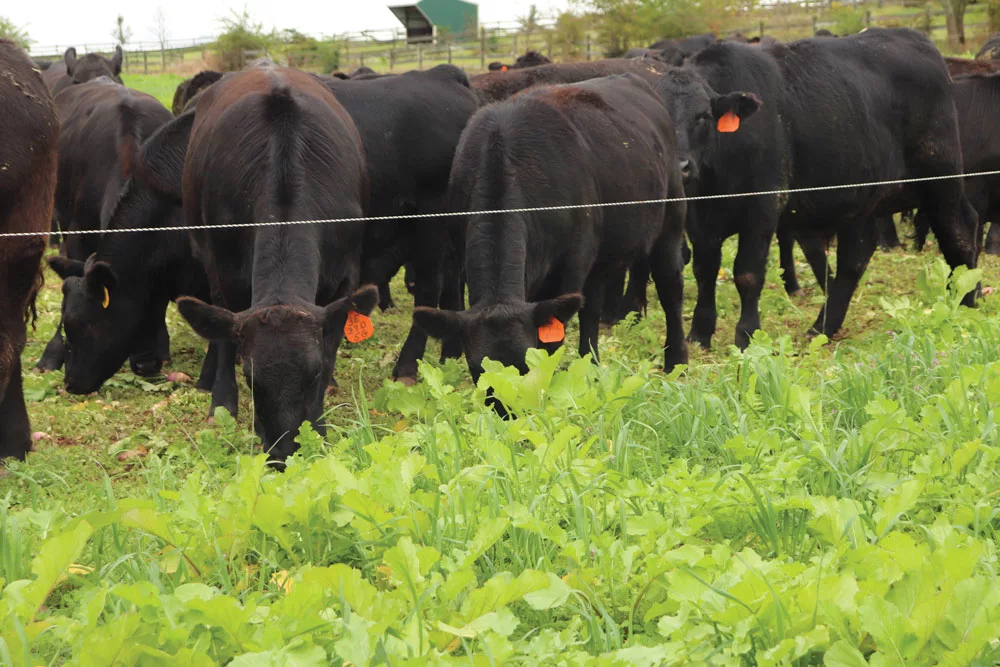
When grazing cover crops, farmers aim to provide nutritious forage AND severely stunt vegetative growth through intentional over-grazing. This is best accomplished through mob grazing or other forms of intensive rotational grazing wherein livestock are confined within small temporary paddocks at high stocking rates for a short amount of time.
Animals can be confined using either temporary or permanent fence:
Permanent Fence: Most permanent fence consists of 3-5 strands of electrified wire.
Temporary Fence: Temporary fence is a more cost effective option for (1) livestock well trained to a hot wire and (2) areas where animals are not likely to cause a threat to human safety should they escape.
Harvesting Hay or Haylage?
Farmers who don’t have the option of installing fence or grazing can harvest the cover crops as a second spring crop.
Cover crops will create high-quality forage with large income potential. However, the harvest and removal of the above ground biomass reduces potential soil health gains.
Expert Tip... Treat your cover crop like a cash crop
Farmers removing cover crops should treat their cover crops like their cash crop and ensure these fields receive appropriate fertilizer/manure to compensate for lost nutrients.
Planting After Termination
Grazing will not fully terminate cover crops. Grazing severely reduces the above ground biomass and stunts the crop’s growth. However, farmers need to employ a secondary termination strategy to achieve full termination. Most farmers will use a light application of herbicide or tillage to terminate the remaining cover crop.
Expert Tip... For farmers without livestock
Grazing cover crops provides economic and soil health benefits to row crop acres. However, not every crop farmer has livestock, and not every livestock farmer grows crops.
With adequate planning, it is possible to develop an arrangement between two farmers so that cover crops can be utilized to benefit both parties. Search “Contracts for Grazing Cover Crops” for assistance developing agreements.

No-Till Farmer's "Getting Started With No-Till Farming" is brought to you courtesy of Calmer Corn Heads.
Farmer Invented. Farmer Tested. Farmer Proven.® Calmer boasts this motto proudly as it references our farmer-first mentality and state-of-the art technology.
Calmer offers a custom experience, suited to your farm’s needs. Whether its talking with our experienced sales team or directly with the folks who designed and built your corn head, we are committed to providing you top-notch service without the red tape of a big corporation. Calmer specializes in products suited to benefit your no-till operation including the patented BT Chopper® Stalk Rolls, versatile Corn Head Upgrade Kit for harvest efficiency and residue management, and the High-Performance Concave Upgrade Kit.
We know Calmer products work because we run them on our own farms; that’s why we offer a 100% Satisfaction or Your Money Back Guarantee!