 Premium content is for our Digital-only and Premium subscribers. A Print-only subscription doesn't qualify. Please
No-Till Farmer
Get full access NOW to the most comprehensive, powerful and easy-to-use online resource for no-tillage practices. Just one good idea will pay for your subscription hundreds of times over.
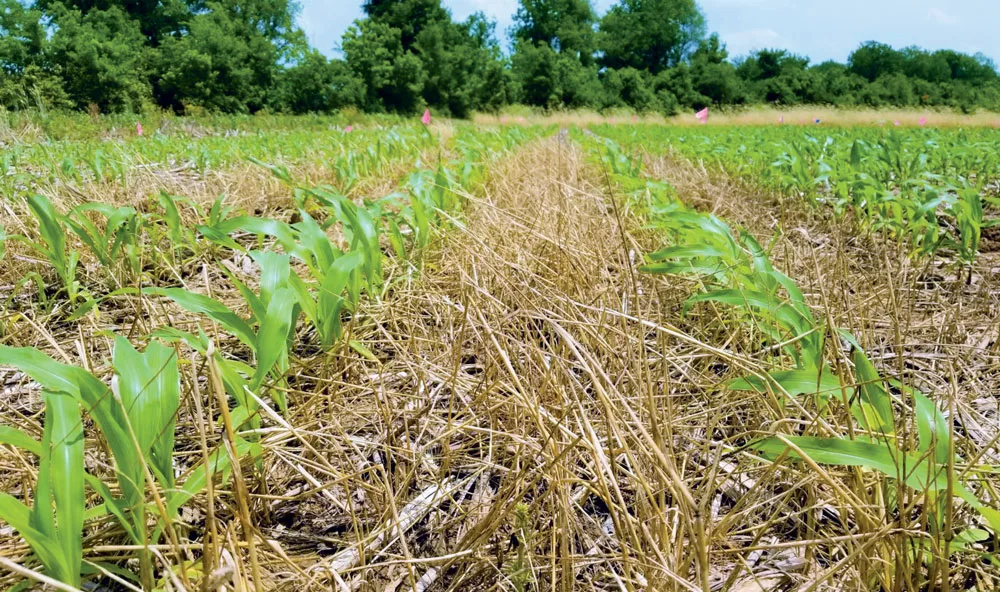
STAYING PUT. Corn planted following a cereal rye cover crop in a no-till system. Purdue Univ. research shows cereal rye can be an effective tool for reducing nitrate and P and K losses from farm fields. Univ. of Kentucky
Cover crop use, like no-tilling itself, is a primary qualifying practice among many in USDA’s newly launched NRCS Regenerative Pilot Program. But cover crops themselves play a significant role in erosion control and bulking up other program-prescribed conservation, practices such as nutrient and drainage-water management.
The Regenerative Pilot Program announced in late 2025 calls for whole-farm assessment of soil and water resources; provides a list of 15 approved conservation-related farming practices and requires soil-health testing in the first and last years of the cost-share contract.
A single application provides access to NRCS cost-share for qualifying practices under the existing EQIP (Environmental Quality Incentives Program) and CSP (Conservation Stewardship Program).
The $700 million program also encourages bundled practices including: cover crops, no-till/reduced till, diverse rotations, managed/prescribed grazing, silvopasture, nutrient management, and livestock integration — and is open to growers already using at least one of the regenerative practices and for those adopting one or more of the listed practices.
Thirty years of research in the Corn Belt show cover crops — particularly when bundled with other conservation practices — reduces nutrient levels in drainage water from tiled fields, and from surface runoff experienced in heavy rains on unprotected soils.
Eileen Kladivko, who oversaw ongoing tile-drainage studies beginning in the mid-1980s at the Southeast Purdue Agricultural…

Get full access NOW to the most comprehensive, powerful and easy-to-use online resource for no-tillage practices. Just one good idea will pay for your subscription hundreds of times over.
Download these helpful knowledge building tools

We have engineered and developed the most advanced concave system that threshes all crops, eliminates rotor loss, improves grain quality, gives you a cleaner sample – all with one set of XPR concaves.

At Titan International, our product portfolio reflects our commitment to innovation and high-quality products. Titan International offers a full line of solution-focused wheel, tire, and undercarriage products for a wide variety of off-the-road equipment in agriculture, construction, forestry, mining, power sports, high-speed trailers, and outdoor power equipment segments. As one of the largest North American manufacturers, with a network of dealers all over the world, Titan is an industry leader that original equipment manufacturers and operators can count on for durable products and quality service.

Provide expert analysis and decision support to increase productivity and profitability.