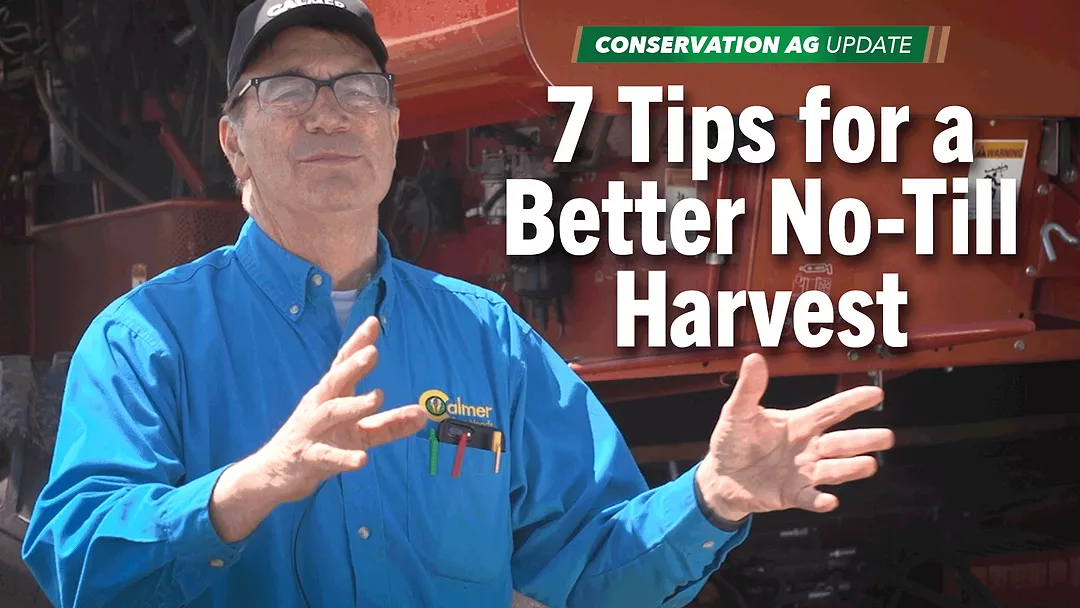
On this episode of Conservation Ag Update, brought to you by Bio Till Cover Crops, No-Till Innovator Marion Calmer checks in from Alpha, Ill., with 7 tips for a better harvest. Plus, we pay a visit to Tony Peirick’s farm in Watertown, Wis., for a conversation about planting green and whether you need to overhaul your equipment to make the practice work. In the Cover Crop Connection, associate editor Mackane Vogel reports from the FIRA USA conference in Woodland, Calif., with a look at potential game-changing technologies for cover croppers.
Speaking of technology, precision ag specialist John Fulton from Ohio State Univ., shines light on 2 products delivering ROI for no-tillers in his neck of the woods. In the video of the week, Conservation Ag Operator Fellow Michael Thompson shows how he’s using vermicompost to improve the resiliency and root mass of his no-till crops in Almena, Kan. And finally, No-Till Legend, John Bradley explains why the National No-Tillage Conference is an event he always has on his radar.
This episode of Conservation Ag Update is brought to you by Bio Till Cover Crops.
Bio Till Cover Crops, a pioneer and leader in cover crop seeds, represents a complete lineup of seeds suitable for use in diverse soil types and growing conditions. Our focus on cover crop and regenerative forage seeds sets us apart from suppliers invested in other markets. Dealers in our distribution network are committed to your success by providing local resources, education and guidance to ensure you have the correct foundation for success. With over 50 years of experience in production, processing, packaging, and shipping, you won’t find a better fit for your farm.
TRANSCRIPT
Jump to a section or scroll for the full episode...
- Marion Calmer’s No-Till Harvest Tips & Insights
- Do You Need a Special Planter to Plant Green?
- Cover Crops & Autonomy — Don’t Lose the Plot
- Two Technologies Delivering ROI for Farmers
- Video of the Week: Improving Root Mass with Vermicompost
Marion Calmer’s No-Till Harvest Tips & Insights
We haven’t had an official Crop Progress Report in over a month due to the government shutdown, but it sounds like most of you are probably nearing the finish line with harvest. And it’s never too early to start thinking about how to improve for next year. Let’s kick things off with 7 harvest tips from No-Till Innovator Marion Calmer.
“One of the things I do with a pickup truck is drive behind the combine and I want to see what’s coming out of the straw chopper. If you see a lot of yellow, that means the corn head is breaking off a lot of stalks or the stripper plates are too tight or something’s wrong. I would prefer to see a red tint out of the straw chopper than a yellow tint. It tells me I’m mainly sending whole cobs out the back end of the combine.”
“Stripper plate gap. Measure the girth of the stalk and make sure that you never get the stripper plates tighter than the diameter of the stalk.”
“I like finely chopped cornstalks, they decompose fast, they return nutrients, earthworms love them. If I’m in a corn-soybean rotation, when I come back to push the platform down the field cutting my no-till beans, the residue is all chopped up and it flows through the header late at night when it starts getting damp.”
“On a red combine, we can adjust the transport vanes. They’re in the fast position for beans. Slow position for corn. On a green combine, I can’t really regulate that.”
“Concave clearance, I’m just looking to see if I have a couple kernels on a cob, that’s how I adjust. The rotor speed, it’s all about the cracks. The fan speed is about the amount of leaves that are in the grain tank. The sieve settings, run the bottom one wide open.”
Calmer will share more keys to success during the upcoming National No-Tillage Conference. Check out the program and dates at NoTillConference.com.
Do You Need a Special Planter to Plant Green?
Watertown, Wis., no-tiller Tony Peirick has been reaping the benefits of planting green into living cover crops for several years now. And he says he didn’t make any big changes to his planter when he started doing it.
“We don’t even need the no-till coulters anymore. A lot of people think they must have a special planter. Just go slow and add a little extra weight and a lot of times it will go in the ground. You don’t have to spend a lot of extra money for this no-till stuff. Once your soil structure changes then it will be a lot easier to penetrate. It’s not a big cost. Now a days, a lot of these planters are well set up for downforce pressure, which you need to push the unit in the ground. A lot of these planters are capable (of planting green). You can get involved with this, and it works.”
Tony says it’s amazing how much NPK cereal rye gives back when it decomposes. But since it’s such a big consumer of nitrogen (N) when it’s alive, he applies 20 gallons of 28 or 32 with his planter to make sure the corn has enough N to get off to a good start.
Now let’s send it out to Mackane Vogel for a special West Coast edition of Cover Crop Connection on the road at FIRA USA.
Cover Crops & Autonomy — Don’t Lose the Plot
Autonomy is always one of the biggest topics talked about here at FIRA USA. Earlier there was a panel where the topic of cover crops came up in terms of autonomy and let’s take a listen on why it might be important to just pay a little more attention to cover crops when you’re dealing with AI or autonomous farm equipment.
“Some of the challenges we typically run into are really around how these environments are set up. You might have uneven terrain. You might have certain scenarios where the ground cover exists. You might have certain scenarios where the actual task you’re doing — maybe you’re trying to mow a cover crop but it’s the beginning of the season and the cover crop is 3 feet tall. How do you actually effectively build an autonomous solution that understands the difference between what’s safe to actually touch and what’s the responsibility of the task you are trying to solve for. You have dust, you have fog, you have all kinds of different types of scenarios. You might have water or low spots that the vehicle might get stuck in or muddy conditions. And if you can’t solve for all these different types of scenarios from an autonomous perspective then the value proposition of these vehicles doing automated work is really limited because someone is always going to have to go help these systems out. So how do we think about building an autonomy solution that allows you to handle all of these different types of scenarios? And that is really what Agtonomy has been focused on the last few years.”
Well that’s all for this week’s cover crop connection. We’ll have lots more content for you in the coming weeks from FIRA USA.
Road warrior Mackane is now on his way to AGRITECHNICA in Hanover, Germany. He’ll join us from there on our next episode.
Two Technologies Delivering ROI for Farmers
And another guy who’s on his way to AGRITECHNICA is precision ag specialist John Fulton from the Ohio State Univ. I caught up with him before he left and put him on the hot seat with this question.
Noah: “In your experience working with farmers and some of the on-farm trials at the university, what’s one new product, technology or practice that you’ve seen giving farmers a lot of bang for their buck?”
John: “Here on the eastern Corn Belt, we’ve seen an uptick in the utilization of drones. It’s helping farmers to be more efficient, and timely in terms of applications. We’re seeing some profit margins out of that.”
“The other one that’s pretty hot, but we’re at an early stage, the last 2 years we’ve seen it come to commercialization, is targeted spraying. Where does that fit or does it fit? Those are some of the questions that growers are going through now. There are some situations where it makes sense today, but maybe not quite for other growers in terms of how they’re managing their crops.”
Looking forward to seeing what John uncovers at AGRITECHNICA next week.
Video of the Week: Improving Root Mass with Vermicompost
Let’s catch up now with our Conservation Ag Operator Fellow Michael Thompson out in Almena, Kan. In this video, Michael shows us how he’s using vermicompost to improve the root mass and resilience of his crops.
“Got a compost extractor here. The last several years we’ve kind of done a little bit with vermicompost, which is worm poop basically. The vermicompost we’ve been treating seed with up until now. We have a planter set up with liquid now so we’re going to start extracting. We take the dry compost extract and put it in the basket here. You fill this tub up with water. It has an aeration fan on it. The aeration actually bubbles it and this basket has the mesh screen, so basically all the fines are kept in the basket, and it filters them out, so you don’t have them in the liquid system. You fire up the pump, take it off and put it into your planter or drill.
“We’re looking at it to help with the root systems of the plant. From just treating the seed, we’ve seen increased rooting mass and that helps us in our dryland environment to get through the drier times. But also, it’s something that we’ve seen a lot of with plant health that our plants seem to have that darker green and seem to survive those drier times when we have flash droughts where we might have a month without rain. It helps with the plant to be a little bit healthier.”
That’ll do it for this week. Got something you’d like to feature on the program? Shoot me an email at Nnewman@Lessiter Media.com. Thanks for tuning into Conversation Ag Update. Until next time, for more stories visit no-tillfarmer.com, striptillfarmer.com and covercropstrategies.com.