

Brought to you by:
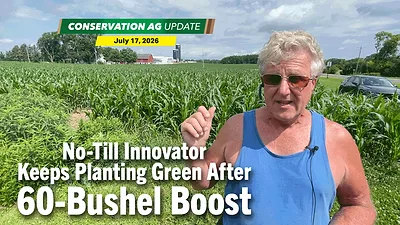
On this episode of Conservation Ag Update, brought to you by Yetter Farm Equipment, Michael Thompson, No-Till Farmer’s 2025 Conservation Ag Operator Fellow, shares how he’s alleviating compaction with an AerWay unit in Almena, Kan. Plus, no-tillers exchange ideas and strategies for fighting slugs in soybean fields.
In the Cover Crop Connection, Elizabethown, Pa., no-tiller Jim Hershey conducts an experiment with cover crops and vegetables.
Later in the episode, Jeremy Peters, CEO of the National Association of Conservation Districts, explains why it’s never too late to give conservation practices a try.
And in the Video of the Week, Lucas Horsch, CEO of Horsch North America, fills us in on brand-new equipment that was unveiled at the grand opening of the company’s AgTec building in Cottage Grove, Minn.
|
|




|
|
Conservation Ag Update is brought to you by Yetter Farm Equipment.
Since 1930, Yetter Farm Equipment has been providing farmers with profitable solutions. From residue management and fertilizer placement to seedbed preparation, our equipment is designed to maximize your inputs, save you time, and deliver a strong return on investment.
Explore our full line of planter attachments, precision fertilizer placement options, strip-till units, and stalk rollers at yetterco.com. Let Yetter help you prepare your equipment lineup for success today.
Full Transcript
Mackane Vogel:Mackane Vogel here. We are in Elizabethtown, Pennsylvania, Harvest View Barn at Hershey Farms home of Jim Hershey. Welcome to Conservation Ag Update.
Noah Newman:Conservation Ag Update is brought to you by Yetter Farm Equipment. Hey, welcome to the show. Great to have you with us as always. We begin in northern Kansas with 2025 Conservation Ag Operator Fellow Michael Thompson. So he is been dealing with some compaction issues in his in-rows and turn-rows where there's heavy grain cart and tank traffic. Well, Michael found a solution in the form of an AerWay vertical tillage machine. Let's see how it works.
Michael Thompson:We've been long-term no-till since 2000, and so we're starting to see just a drag in those crops that they're not doing as well. And I think a lot of it's they don't have enough air in there. There's not enough water getting into those places and enough biology happening. So my intentions with this, we just replaced all the blades on this AerWay, so I'm going to put some saddle tanks on there and run some compost, dribble some compost extract behind the AerWay when we're running those in those high traffic areas to try to relieve some of those compaction zones and those compaction areas in the field.
This would just bring some air into the mix right away, just kind of a temporary fix that we'll get back to cereal rye, hopefully more on those areas, those high traffic areas. And basically this is just a way of trying to get some of those compaction areas like where we've parked the semi or where we've loaded out. Same way with where we've had tanks or something in our fields, steel tanks and stuff where we've had a little compaction around those from where the cattle come to water. So just something that I'm trying to see if I can alleviate some of those compaction zones without full-fledged tillage.
Noah Newman:Interesting stuff there. You can follow along with Michael throughout the growing season on no-tillfarmer.com. Well, a north central Ohio no-tiller is having a terrible time with slugs in his cereal rye soybean fields this growing season. So he asked for some help in the No-Till Farmer email discussion group. Let's see what some people said. Doug Honick says he might want to check for copper in the soil. He read that slugs are sensitive to it. Doug tested his soil in 10 acre grids and the test showed a zero for copper. So he applied a product called Orbix that contains many micronutrients. H. Grant Troup checked in with several considerations. Number one, don't use broadcast insecticide and be careful with seed applied neonic insecticides. Both are effective at eliminating slug predators. Number two, spread or banned fertilizer over the soybean row at planting. Slugs and salt don't get along well.
His third recommendation, he says, apply seed treatments to speed emergence and early growth to help outgrow the slug. Four, when able clean the row of crop residue and cover crop to eliminate day housing for the slug population. He says, slugs take cover on sunny days. Make sure they go elsewhere for protection from that sunlight. Number five, make sure the planter is doing a positive row closure by interlocking the seed furrow sidewalls. An open seed furrow is a superhighway for slugs and other pests. And as far as copper and other micros go, Grant says the main concern here is having the right amount in the soil for optimum growth and yield. Too much copper could be bad news. And Grant says if all else fails are our slug pesticides you can use as rescue treatments. Time now to check in with road warrior Mackane Vogel for today's Cover Crop Connection. Mackane, what you got?
Mackane Vogel:Thanks, Noah. Mackane Vogel here with this week's Cover Crop Connection. Well, earlier this month I visited Jim Hershey's farm in Elizabethtown, Pennsylvania. In our last episode you had a chance to see what his plans are for the upcoming Pennsylvania No-Till Alliance Field Day. This week I thought I'd showcase one of Jim's latest experiments. Check out what he's doing to prove that cover crops can work in a garden environment to suppress weeds and help grow healthier vegetables.
Jim Hershey:So we will demonstrate how you can actually raise vegetables in your garden with the use of cover crops. Now this typically, you wouldn't plant these cover crops in the spring. You would plant something in the fall, but this is what I think is cool. This here was undisturbed soil, no cover crop seed planted and look at all the weeds coming up. So you already got an issue gone here. That would give you a challenge. That's why people struggle with gardens. How do I take care of the weeds? Well, that over there would help. Now, I mean, to get the whole story there, you're likely are going to have to either keep the cover crops trimmed down or lay newspaper down, but it's still better than pulling weeds. So that's one project we got involved in because someone at one of our events, I think it might've even been at the State Farm Show, when they seen the rainfall simulator and they saw the cover crops, they said, "Well, could I do something like that in my garden?" And we said, "Yeah, you can."
Mackane Vogel:Hershey says, the cover crop mix he used includes oats, buckwheat and crimson clover, and he intends to plant tomatoes, lettuce, cabbage, and peppers for the experiment. Well stay tuned next month for an upcoming cover crop podcast series detailing all the farms I visited in Maryland and Pennsylvania this summer. But until then, that's all for this week's Cover Crop Connection. Back to you, Noah.
Noah Newman:Good stuff. Thank you very much, Mackane. The NRCS is celebrating its 90th anniversary. We caught up with Jeremy Peters, CEO of the National Association of Conservation Districts in Washington, D.C. and after all these years, Jeremy tells us there's still one big message they're hammering home.
Jeremy Peters:It's never too late to do the right thing. It's never too late to start that journey. We've got a lot of early adopters within our organization that had been experimenting with no-till and cover crops way before they were as well known as they are today. These were people that were taking risks. They were trying something different either because they wanted to try something different or because they had to because their economics were failing them and they needed to try something different. So I would say that it's never too late to try the right thing and to experiment with new practices. Take a portion of a field and try cover crops and see how it works. Or many conservation districts offer no-till drills for rent. You don't have to invest in the equipment necessarily have that big capital expense, but you can rent a no-till drill from a local conservation district and give it a try for a season and see how no-till works on your operation.
Noah Newman:From D.C. to Cottage Grove, Minnesota, now where farmers and dealers gathered for the grand opening of the Horsch Ag Tec building, they had a front row seat to some big equipment reveals, including a massive ninety-foot planter and a huge air seeder cart that they're calling the biggest one in the market. Lucas Horsch, CEO of Horsch North America says it's all about becoming more productive and overcoming all those labor challenges that so many farmers seem to be dealing with today.
Lucas Horsch:In the ag industry, we are lacking more and more people, not because we don't have people, but we don't have the right people sometimes in the locations where we are. And in the end today, the theme, what we talked about is basically the productivity side. We are now moving into the ninety-foot planter market and we are moving now to the big air seeder market with up to 900 bushel tanks and so on. I think that's very important pieces to this story. And on the other side, we are driving our sprayer business forward, and I think when it comes into resistances, wheat resistances and so on, I think we need to work more on our quality of application and quality of application are two pieces to it.
I think one is maybe to slow down our operation, sometimes maybe go to a wider broom hence to upper or to raise our volume, basically have a better coverage. I'm not disagreeing that you can go with low volumes and you can have the right tip to have this low volume when the conditions are right. But with all the climate, what we have today, we don't have always the perfect conditions. Sometimes you have a windy day, sometimes you have a too dry of an air that the fine droplets are drying up too quickly.
Noah Newman:Big thanks to Lucas for taking the time to talk with at their big event, and that'll wrap things up for this week's Conservation Ag update. Send me an email nnewman@lessitermedia.com if you have any story ideas. Thanks so much for watching. We'll see you for our next episode, July 4th, Independence Day. Have a great day.