
No-Till Farmer editors encounter a variety of articles, social media posts, podcasts and videos that offer a unique look at the grower's world from the lofty digital realm. Here is our favorite content from the past week from across the web:
- How to Make No-Till Farming Work with Other Soil Health Practices
- Is Your Soil Alive or Dead?
- First Hand Knowledge from the Farm — Cover Crops & No-Till Tips for Success
- No-Till Soybean Research — Planting No-Till Soybeans After Cotton
- Highlighting Farmer-Led Innovations in Reduced Tillage
How to Make No-Till Farming Work with Other Soil Health Practices
No-till adoption has sky-rocketed in the last few decades. In 1989 approximately 14 million acres were under no-till cultivation. As of 2022 no-till acreage had increased to over 105 million acres. Clearly, farmers like what they see with no-till. But still... it isn't a black-or-white fix-all and viewing it as such creates a lot of problems. In fact, data shows that when a farmer converts to no-till but doesn't integrate any other soil health practices, it can actually do more harm than good. Check out this YouTube Short from NRCS South Dakota and read the accompanying article for peer-reviewed research on the keys to making no-till work.
Is Your Soil Alive or Dead?
In this video, Minnesota no-tiller Jon Stevens uses the microbiometer kit and tests a conventionally tilled field versus a no-till field versus a no-till field that had some tillage incorporated. Which field will score the highest?
First Hand Knowledge from the Farm — Cover Crops & No-Till Tips for Success
Mark Legvold farms near Northfield, Minn., and uses no-till and cover crops on his farm. Here's how he does it.
No-Till Soybean Research — Planting No-Till Soybeans After Cotton
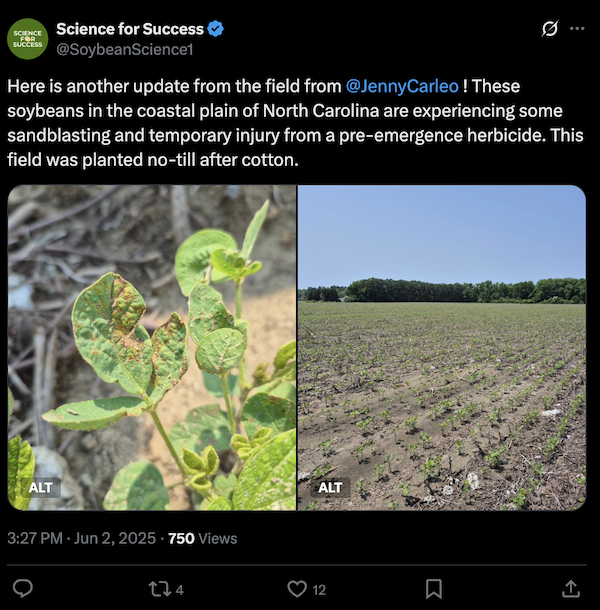
Check out this post on X, formerly Twitter, which shows an update on a soybean field at NC State Extension. These soybeans in the coastal plain of North Carolina are experiencing some sandblasting and temporary injury from a pre-emergence herbicide. This field was planted no-till after cotton.
Highlighting Farmer-Led Innovations in Reduced Tillage
American Farmland Trust's New England project called “Farmer Led Innovations in Reduced Tillage" facilitates peer learning and provides financial and technical support to farmers who are innovating reduced tillage practices. One of the participating farms was Freedom Food Farm in Raynham, Mass. Chuck Currie, and his partner Marie Kaziunas, focus on creating a holistic farm system that prioritizes soil health and on-farm fertility. Last summer, Freedom Food Farm hosted a field walk to share their methods of reducing tillage.
Is there something you want to share in "This Week"? Send us an email.