On this episode of Conservation Ag Update, brought to you by Yetter Farm Equipment, Arion, Iowa, no-tiller Kelly Garrett discusses the importance of balancing the soil during planting seasons. Plus, Kyle Hawkins explains how changing his planting date allowed the Bogard, Mo. no-tiller to win the Golden Harvest “Go for the Gold Challenge” with a 103-bushel soybean yield.
In the Cover Crop Connection, associate editor Mackane Vogel speaks with Agoro Carbon Alliance's Lisa Kubik about a curious case of accidental planting green.
Later in the episode, PTI Farm Manager Jason Webster shares the findings of the Precision Planting PTI Farm’s new High-Speed Planting Study. Plus, soil health legend Jerry Hatfield provides a sneak peak of his upcoming presentation at the National Strip-Tillage Conference, and finally in our Video of the Week, Vincennes Ind. no-tiller Ray McCormick shows off his newly finished natural pond.

This episode of Conservation Ag Update is brought to you by Yetter Farm Equipment.
Since 1930, Yetter Farm Equipment has been providing farmers with profitable solutions. From residue management and fertilizer placement to seedbed preparation, our equipment is designed to maximize your inputs, save you time, and deliver a strong return on investment. Explore our full line of planter attachments, precision fertilizer placement options, strip-till units, and stalk rollers at yetterco.com. Let Yetter help you prepare your equipment lineup for success today.
TRANSCRIPT
Jump to a section or scroll for the full episode...
- Kelly Garrett’s Key to Balancing No-Till Soils
- No-Tiller Goes for the Gold with Early Soybeans
- Planting Green… By Accident?
- Conservation Conversation: Jerry Hatfield on Soil Health & Strip-Till
- How Does Planting Speed Impact Yield?
- Video of the Week: Ray McCormick’s Natural Pond
Kelly Garrett’s Key to Balancing No-Till Soils
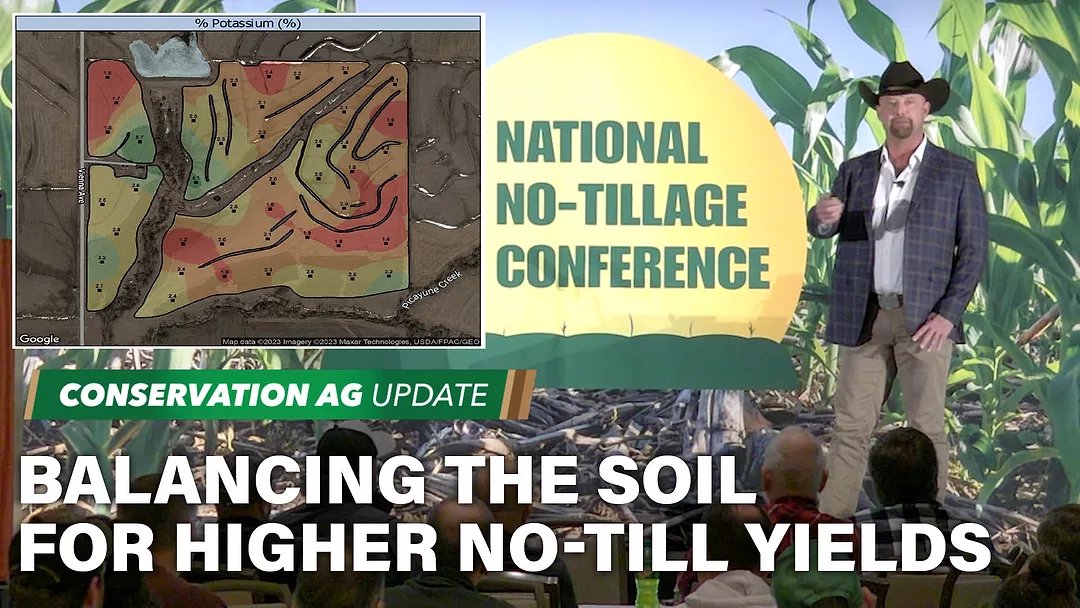
Welcome to Conservation Ag Update, great to have you with us as always. I’m Noah Newman. 18% of corn is planted nationwide, and about 11% in Iowa, which is where we find our good friend Kelly Garrett. The Arion, Iowa, no-tiller is once again primarily focused on balancing his soil this planting season. Here’s why.
“And I talk about balancing the soil, and I talk about balancing the plant. And my first priority is balancing the soil. If you don't balance the soil, your input dollars, your input budget is at least partially wasted. And a lot of farmers, a lot of growers, myself up until just a few years ago, I didn't understand base saturation. And it needs to be the number one priority.”
“You can see in the red areas there, base saturation on the potassium is below 2. Base saturation to me is the balance of the soil. Perfectly balanced soil, in my opinion, is 65% calcium, 13% magnesium, 4% potassium. There are other things that go into it, but those in my opinion are the three most important ones. Hydrogen would be right there. Nobody's probably ever brought up hydrogen to you, but hydrogen would be right there. Your highest yielding soils, I can almost assure you have the appropriate amount of hydrogen.”
“So, the potassium here, we want to look at the red areas where it's down below. Perfectly balanced soil, as I said, is 4. The red areas are below 2. You're going to go put potash out in there, you're wasting your money.”
Garrett says there’s no reason to apply it there without amending the soil. Catch more of his No-Till Conference presentation on No-TillFarmer.com
No-Tiller Goes for the Gold with Early Soybeans
Bogard, Mo., no-tiller Kyle Hawkins cracked the high-yielding code for soybeans when he took home first place in the Golden Harvest “Go for the Gold Challenge” with a 103-bushel yield. Hawkins says his yields started taking off when he changed his planting date.
“We started in 2020 doing early planted soybeans. The 1st of April we go out there and start planting. It was a battle getting my dad on board with this. We had really good yield results. We had 37 acres that averaged 101 bushels per acre. It was kind of a shock and awe thing because we’ve never had anything like that. It was enough to give you an idea that we could potentially have something good going here. We’ve hit 90s, 80s as the years went on. Planting soybeans early has been key, and we do some other microbial stuff with another company that gives us a pop.”
Hawkins no-tills 5,000 acres of soybeans.
Planting Green… By Accident?
Earlier this week I had a chance to catch up with Lisa Kubik. She’s an Iowa grower who grazes cattle and grows corn, soybeans and cover crops, but she also works with growers through Agoro Carbon Alliance. She told me about a cover crop case study and another Iowa farmer she recently worked with who saw great cover crop success by — get this — accidentally planting green. Here’s Lisa with the full story.
“As with a lot of our farms, we have a plan going in and sometimes it doesn’t work out quite like we planned. So, with this specific grower, his original plan was not to plant green, but he ended up planting green and luckily for him, it turned out to be a great experience. There were some places where he had a little bit of effect on germination where he saw a few less plants that germinated just because of the cereal rye that was still there. But in most cases, the crop came up beautifully as long as his row cleaners were working well, which happened on most of the fields. Last spring, which is when he first tried this cover crop, we did have a ton of rain — just heavy rains all at once. And he could see a pretty dramatic difference from where he didn’t have cover crops to where he did. He said, visually, there is a big difference as far as erosion control and where he was able to see that rain actually truly saturating the soil. In this area where we haven’t had a lot of rain in the last couple years, being able to soak in some of those big rains when we don't get the little rains, will make a big difference. So, overall, he did see a benefit in the cover crops, and didn't see any issues as far as compaction. The field that we specifically talked to him about has been chopped for silage the last two years. Typically we see a lot of compaction from that practice. There’s not a lot of residue left and we are running pretty big machinery over that ground. So, he is seeing no compaction which I would attribute a lot of that to that cover corp continuing to grow, as well as our cash crop of course.”
Well a great story there that just goes to show — sometimes the most valuable lessons on the farm are learned by accident. Well that’s all for this week’s Cover Crop Connection.
Conservation Conversation: Jerry Hatfield on Soil Health & Strip-Till
Special treat now — I caught up with soil health legend Jerry Hatfield to talk about his upcoming presentation at the National Strip-Tillage Conference and also the keys to expanding our knowledge about soil health. Here’s part of our conversation.
Jerry Hatfield: “We want our soil to supply water, nutrients, provide support, oxygen exchange. When you look at all that relative to strip-till, we’re only cultivating a narrow band of this system out there. And you’ve got all the residue on there, so you have protection of the micro-climate, we’ve got that water dynamic, a stable home for the microbes to do their thing. All those different pieces contribute to soil health. What are the avenues to soil health? And then you flip it back and see what strip-till does in terms of those avenues, and they’re headed right down that path. People need to understand that these dynamics are critical to helping us bring all this together. That becomes a critical piece of how we begin this understanding.”
Noah Newman: “What can we expect from a Jerry Hatfield presentation?”
Jerry Hatfield: “It’s really about how do you communicate to producers. I have 45 years of science, but my dad taught me, take all that science and make it understandable for producers. That’s what you get out of this. Everyone in the audience should have something to take away. And if not, ask questions about it. I’m available before and after conferences. How do we work together in this understanding? Because there are things that I admit I don’t quite understand yet because we deal in a complex system. I pick up some of my crazy ideas of what needs to get done from producers that ask questions. It’s about a dialogue and that’s what I hope this presentation does, create a dialogue.”
Noah Newman: “I’ve seen your presentations before. You’ll share some things that are normally complex, but you do a good job of taking that complex data and information and transforming it into a story that’s understandable.”
Jerry Hatfield:“That’s my goal, to make it understandable. When I retired from the USDA, people asked me what I was going to do. I said I’m going to help agriculture. To help agriculture you have to work with agriculture, you can’t just stay above it. You have to get your hands dirty, so to speak. But you also have to pay attention to what’s going on, and not being afraid to say I don’t know, but together we’re going to figure it out.”
Looking forward to seeing Jerry Hatfield at the National Strip-Tillage Conference, July 31-Aug. 1 in Iowa City. For more information, head to StripTillConference.com.
How Does Planting Speed Impact Yield?
Precision Planting PTI Farm’s new High-Speed Planting Study is out. And PTI Farm Manager Jason Webster says the data shows that not only were yields maintained at higher speeds, but they actually increased in some spots.
“Traditionally, there's some growers that really felt that the only way they could do a good job of planting is if they planted slower. And yes, that was the case years ago, decades ago, but now we've got technology, high-speed planting technology, where we can plant faster without sacrificing performance. To prove this, we've looked at yield data. We put trials in. We put protocols in at the PTI farm. From 2018 to 2024, we planted at 4, 6, 8, and 10 mile an hour planting corn, and there's just been very little yield difference from those planting speeds. Matter of fact, there's only been a 2.1 bushel difference from the slowest speed to the highest speed. What does this mean? Well, it means with SpeedTube high-speed planting technology, you can plant faster and you don't have to worry about yield falling off. It's been very, very consistent.”
Now of course, Webster notes these results are based on using high-speed planting technology. The results aren’t the same with non high-speed tech.
“We've tried to do high-speed planting with Seed Tube and it kind of simulates you as a grower. You got Seed Tubes on your planter and you're trying to get done planting the field, and all of a sudden the black clouds come rolling in and it's going to rain, and you say, "Well, let's hurry up and get this field done. Let's throttle up. Let's plant faster to get this field done." Well, we've done that with Seed Tube and we've run into some real problems. Matter of fact, this past year in 2024 where we did that, we took five mile an hour planting speeds, ramped it up to 10 mile an hour with traditional Seed Tubes. We lost 11.5 half bushel of corn times the price of corn. That was nearly a $50 loss on a per acre basis. However, we used that same five mile an hour, ramped it up to 10 mile an hour using SpeedTube, there was only a difference of 0.7 bushel to the acre and a $3 difference on a per acre basis. So, it shows the differences of planting fast with and without high-speed planting technology.”
Video of the Week: Ray McCormick’s Natural Pond
We’re going outside the box with our Video of the Week. No-Till Legend Ray McCormick is always cooking something up on his farm. This year, he built a natural pond to boost biological activity and attract beneficial insects and animals! Check it out.
Those solar panels run the pumps that circulate the water.
That’ll do it for this week. Got something you’d like to feature on the program? Shoot me an email at Nnewman@Lessiter Media.com. Thanks for tuning into Conversation Ag Update. Until next time, for more stories visit no-tillfarmer.com, striptillfarmer.com and covercropstrategies.com.