 Premium content is for our Digital-only and Premium subscribers. A Print-only subscription doesn't qualify. Please
No-Till Farmer
Get full access NOW to the most comprehensive, powerful and easy-to-use online resource for no-tillage practices. Just one good idea will pay for your subscription hundreds of times over.
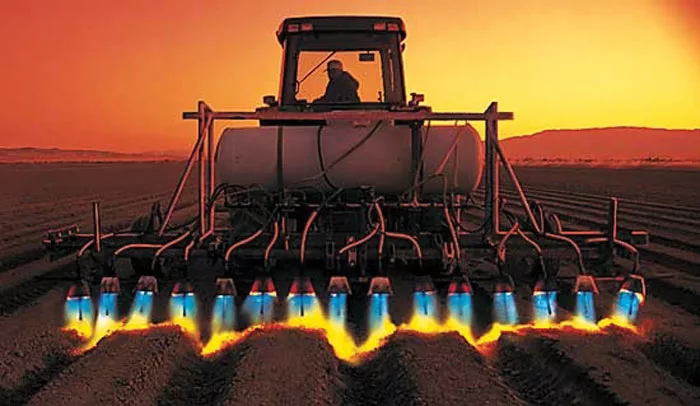
FIRE AT SUNDOWN. An Italian research university found that adding a flame mechanism — like the pictured Red Dragon flamer manufactured by Kansas-City-based Flame Engineering — to the roller-crimp process increased the effectiveness and cut time for cover crop termination.
Cover croppers seeking to improve the effectiveness of using a roller-crimper to terminate standing covers ahead of the planter may want to consider adding flames to the procedure.
Recent Italian studies using three different roller-crimper designs and a separate propane-fueled flaming operation showed significant improvements in plant deactivation and more predictable and timely dry-down of rolled standing covers.
Using propane burners for agronomic weed control has previously been shown an effective method in various row crops in the U.S. For example, a popular 2010 study credited the practice with a 95% control rate on Larry Stanislav’s 300-acre organic corn, soybean and wheat rotation near Abie, Neb.
That research led to the development of a training manual for the practice in corn and soybeans and the commercialization of a 4-row banded/full propane weed control system marketed by Agricultural Flaming Innovations.
The flames do not harm soil micro-organisms nor do they involve tillage. Both subjects are increasingly important to growers seeking to improve soil health. Flaming can also be used in a timely manner regardless of wet soils or when wind might make herbicide applications unfeasible.
The practice has become an approved weed control method for organic farms.
Plant physiologists say exposing weeds, or green material, to flame temperatures above 1,299 degrees F devitalizes proteins within the plant causing a more rapid wilt and desiccation, although it does not destroy plant tissues.
Increasingly stringent European Union controls on herbicides, particularly glyphosate, spawned the 2016-17 Italian studies. University of Perugia researchers published results…

Get full access NOW to the most comprehensive, powerful and easy-to-use online resource for no-tillage practices. Just one good idea will pay for your subscription hundreds of times over.
Download these helpful knowledge building tools

We have engineered and developed the most advanced concave system that threshes all crops, eliminates rotor loss, improves grain quality, gives you a cleaner sample – all with one set of XPR concaves.

At Titan International, our product portfolio reflects our commitment to innovation and high-quality products. Titan International offers a full line of solution-focused wheel, tire, and undercarriage products for a wide variety of off-the-road equipment in agriculture, construction, forestry, mining, power sports, high-speed trailers, and outdoor power equipment segments. As one of the largest North American manufacturers, with a network of dealers all over the world, Titan is an industry leader that original equipment manufacturers and operators can count on for durable products and quality service.

Provide expert analysis and decision support to increase productivity and profitability.