Each month, the conservation ag group at Cornell University offers an analysis of the latest scientific papers dealing with conservation agriculture research from around the world. For this on-going web series, our editors will be selecting several research papers from the Cornell list that will be of special interest to North American no-tillers, strip-tillers and cover croppers.
Sixty years of crop diversification with perennials improves yields more than no-tillage in Ohio grain cropping systems
Conservation Tillage Practices on GHG Emissions, Soil Health and Overall Agricultural Sustainability
Long-term continuous no-till corn-soybean systems: Examining soil carbon sequestration and nitrogen accumulation across various pools
Assessing the agricultural, environmental, and economic effects of crop diversity management: A comprehensive review on crop rotation and cover crop practices
Cover Crops Optimize Soil Fertility and Soybean Productivity in the Cerrado of MATOPIBA, Brazil
Short-term no-tillage improves soil water retention and maintains soil aeration at high moisture conditions despite reduced macroporosity
Tillage Radish as Cover Crop Improves Soil Health Indicators Depending on Pedoclimatic Conditions.
As a result of a challenging fall harvest and a considerable precipitation deficit across much of North Dakota, ranchers are considering options to increase their forage supply. These tips from North Dakota State University Extension can help guide species selections.
With July 1st just around the corner, Mark Sulc, OSU Extension Forage Agronomist, and Bill Weiss, OSU Extension Dairy Nutritionist, help address this year's forage dilemma. If one is looking for quality and quantity, what are your best options?
With significant weather-related damage to corn and soybean fields in Nebraska recently, there could be an opportunity for growers to try seeding cover crops in those fields to raise a high-quality forage and offset at least some of the lost fall and winter grazing potential, says University of Nebraska Extension.
The relationship between current grain prices and forage/pasture prices in western Nebraska is creating a scenario where forage crops may provide an economically viable alternative to a cash grain crop, says University of Nebraska Extension.
A systems approach that includes a diverse crop rotation and a forage crop can no-tillers improve soil health and use irrigation water more efficiently.
On our farm we sampled five fields for biological activity this fall. We waited to sample the fields until the middle of September. The reason we waited was to get some rain so we could get our probe in the ground. We also figured moisture may increase the amount of biological activity.
Wheat stubble can be an excellent seedbed to no-till plant forages, says University of Nebraska Extension. Here are some tips for ensuring a successful stand.
Each year excessive rain, floods, hail, tornadoes, and other calamities of nature create the need to replant crops, often later in the season than you would like.
I tried no-till because of the potential savings I saw, but it’s brought us so much more. Making the switch to no-till has allowed us to raise three high-quality forage crops per year on the 270 acres we intensively farm in the San Joaquin Valley.
Get full access NOW to the most comprehensive, powerful and easy-to-use online resource for no-tillage practices. Just one good idea will pay for your subscription hundreds of times over.
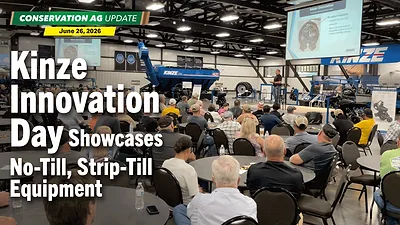
On this episode of Conservation Ag Update, brought to you by Titan International, a big piece of equipment is unveiled at the Kinze Product Innovation Day in Williamsburg, Iowa.
We have engineered and developed the most advanced concave system that threshes all crops, eliminates rotor loss, improves grain quality, gives you a cleaner sample – all with one set of XPR concaves.
At Titan International, our product portfolio reflects our commitment to innovation and high-quality products. Titan International offers a full line of solution-focused wheel, tire, and undercarriage products for a wide variety of off-the-road equipment in agriculture, construction, forestry, mining, power sports, high-speed trailers, and outdoor power equipment segments. As one of the largest North American manufacturers, with a network of dealers all over the world, Titan is an industry leader that original equipment manufacturers and operators can count on for durable products and quality service.