 Premium content is for our Digital-only and Premium subscribers. A Print-only subscription doesn't qualify. Please
No-Till Farmer
Get full access NOW to the most comprehensive, powerful and easy-to-use online resource for no-tillage practices. Just one good idea will pay for your subscription hundreds of times over.

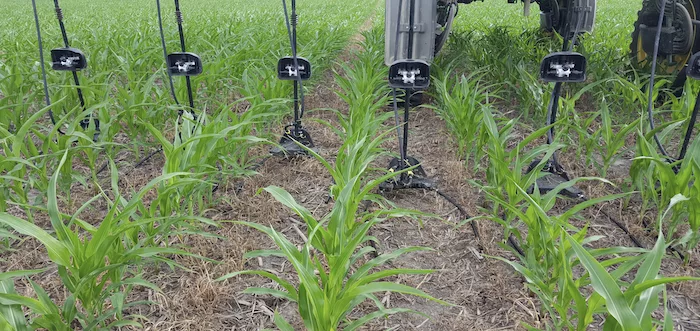
One of Mike Starkey’s earliest no-till aha moments came when he realized the importance of nitrogen application timing and placement with corn. He sidedresses about 70 pounds of N with Y-drops around V6.
| Photo Courtesy: Mike StarkeyMike Starkey’s 7th generation family farm is located in Brownsburg, Ind., right across the street from a K-8 school and the biggest catholic church in the Archdiocese of Indianapolis. Farming next to a major city has some perks, like getting to see his beloved Pacers and Colts in action whenever he wants, but being in a heavily populated area also comes with the usual challenges.
“I have to educate everyone as best as I can about the airplanes flying over our farm,” Starkey says. “Once in a while I’ll go to the school and teach the kids about the kind of farming we do. They tell me their parents think I’m dropping chemicals with the airplanes, but when I tell them it’s cover crop seed, their eyes light up.”
In many ways, Starkey is just like those kids, constantly learning something new about his 3,000-acre corn, soybean, wheat, hay and beef cattle operation. He credits much of his success to his ability to adapt and act when he has those pivotal aha moments, 5 of which have shaped the way he no-tills today.
Starkey learned early on that drainage is a critical component to his no-till system. The old, 4-inch clay tiles his forefathers installed couldn’t handle the increasing amount of heavy rainfall events on his farm.
“A 1-inch rain on the farm was considered a big deal when I was a kid,” Starkey says. “Now, we either get these intense 5-inch rain events all at…

Get full access NOW to the most comprehensive, powerful and easy-to-use online resource for no-tillage practices. Just one good idea will pay for your subscription hundreds of times over.
Download these helpful knowledge building tools

We have engineered and developed the most advanced concave system that threshes all crops, eliminates rotor loss, improves grain quality, gives you a cleaner sample – all with one set of XPR concaves.

At Titan International, our product portfolio reflects our commitment to innovation and high-quality products. Titan International offers a full line of solution-focused wheel, tire, and undercarriage products for a wide variety of off-the-road equipment in agriculture, construction, forestry, mining, power sports, high-speed trailers, and outdoor power equipment segments. As one of the largest North American manufacturers, with a network of dealers all over the world, Titan is an industry leader that original equipment manufacturers and operators can count on for durable products and quality service.

Provide expert analysis and decision support to increase productivity and profitability.