By John Rosendahl, a long-retired former Allis-Chalmers, Deutz Allis and AGCO service department employee.
I just finished reading Frank Lessiter’s book, From Maverick to Mainstream, a History of No-Till Farming. Knowing that I was involved in the beginnings of no-till back in the 1960s, my son recently got me a copy of the book. As a result, I thought you might be interested in some of the things I remember from the very early days of no-till.
First of all, I want to thank you very much, for you No-Till Farmer folks have contributed to the success of the practice of no-till farming over the years. While I am always disappointed to see how much tillage is still going on when I travel the U.S. highways, I am sure I would see far less no-till than I do see if not for your contributions; and for that, I am very grateful for all you have done to promote no-till.
No-Tilling in the Mid-1960s
When the new Allis-Chalmers 600 series planters were introduced to the market in 1966 and 1967, I was working in the service department at the Allis-Chalmers’ West Allis, Wis., home office. In fact, I wrote the first operators manual for these planters. Interestingly enough, the 600 series planter frames were not originally designed with no-till in mind, as I’ll explain.
In the mid-1960s, farmers were trying different row spacings for corn and soybeans, different ways of applying fertilizer — such as “pop up” applied with the seed — using liquid or dry fertilizer, banding herbicides and insecticides as well as combining a final tillage pass with the planter in order to save a trip over to the field.
The 600 series planter frame with three toolbars and individual drive units was designed to meet all of those desires. We called it a “Tinkertoy” planter.
The first toolbar was for mounting spring teeth attachments, the second bar was for the fertilizer openers and the third bar was for the planting units. The wheels could be mounted anywhere on the third bar, so any row spacing from 40 inches down to as little as 15 inches was possible.
No-Till Planter Among the Worldwide Wonders of Agriculture
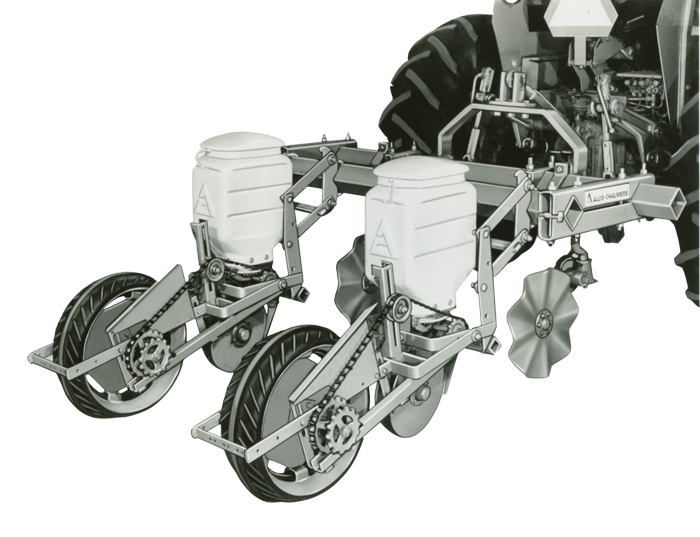
AGRICULTURE INNOVATIONS. The Allis-Chalmers no-till planter was recognized in 1993 as one of the 100 most important worldwide developments in agriculture.
In the late 1960s, Allis-Chalmers developed and manufactured the first commercially available no-tillage planters. Instead of turning under 500-1,000 tons of topsoil per acre with moldboard plowing, the company’s engineers came up with several unique coulter designs and planter frames that turned no-till into a reality.
These planters were capable of no-tilling corn in 15- to 40-inch rows.
In 1993, the Allis-Chalmers no-till planter was recognized by the Equipment Manufacturers Institute as one of the 100 most important developments in agriculture around the world.
Notice that I did not mention mounting no-till coulters on the first bar. That came a year later when the concept of trying to combine a final tillage trip with planting did not work very well, especially on the larger size planters.
The spring teeth units on the front bar would not maintain a uniform depth, causing the planter to shift from side to side and plant zig-zag rows. I remember installing rear-mounted cultivator stabilizers with depth bands on the ends of the front bar to stabilize the planter on an 8-row planter. The next year, 1967, the no-till coulters replaced the spring teeth on the front bar.
“The 600 series planter frames were not designed with no-till in mind…”
The initial 600 series frame sizes were about 140, 180, and 240 inches long, which was close to what was needed for four 40-inch rows, six or eight 30-inch rows, or six, eight or 12 20-inch rows. We put together a 2-row unit later at the request of some universities for their test plots, so it was not the first size, but actually the last size to be built.
The only other thing in your writing about the early Allis-Chalmers planters that I believe was incorrect is where you state that the 17-inch coulter was mounted on the 500 series toolbar. As I recall, the front toolbar on the 500 series planters was not capable of supporting no-till coulters, and I never heard of that happening. Those are the only two inaccuracies I found in your writing of the early days of the Allis-Chalmers no-till planters, which is remarkable since you were not involved prior to 1972.
For several years in those early days, an Allis-Chalmers marketing person and I went around the country putting on meetings trying to sell no-till to our dealers and potential customers. Needless to say, it was not an easy sell.
In those early days, we had a very limited choice of herbicides for weed control, and we did not know that tilling the soil put a lot more carbon in the atmosphere than the tractor exhaust, causing the soil organic matter to decrease over time. We had some success selling the no-till idea in states with poorer or more coarse soils like Michigan, Maryland, New York, and Kentucky where Harry Young already had done it successfully.
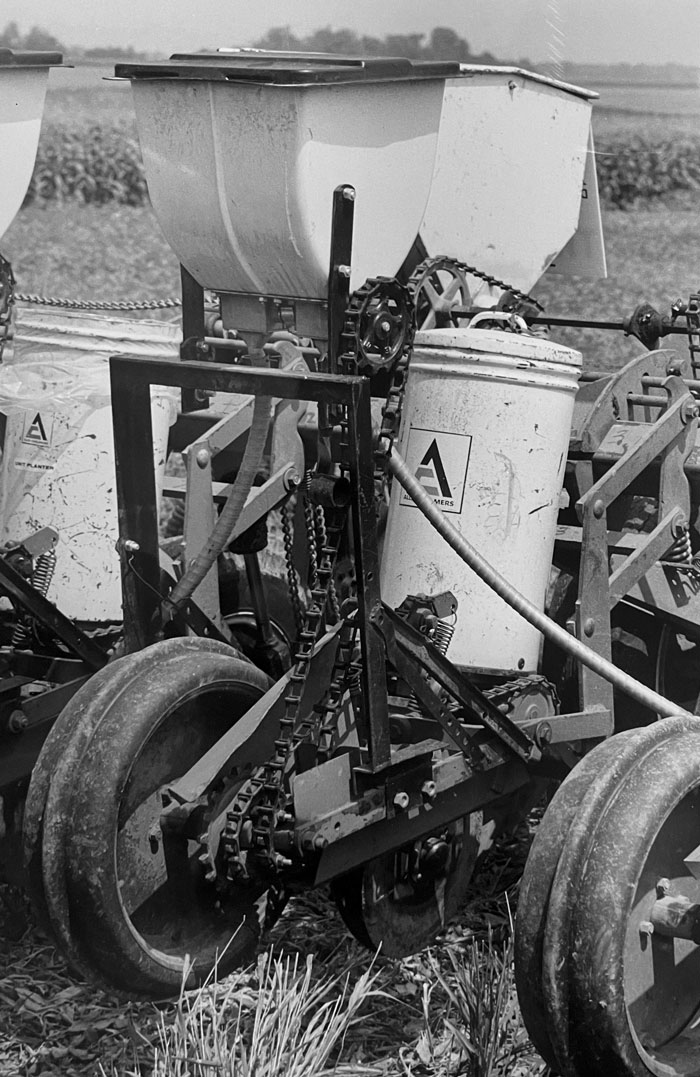
CORN STALKS, SPROCKETS AND DRIVE CHAINS. The most aggravating problem with the early-day row units under no-till conditions dealt with corn stalks getting caught in the unit drive chains and causing the chain to jump off a sprocket. A quick attempt to solve the problem with additional shielding did not solve the situation.
In Maryland, an Allis-Chalmers dealer sold a tremendous number of planters after the few he sold the year before demonstrated the no-till advantage in saving soil after a large amount of rainfall from a hurricane hit the area. He asked me to come out and hold a pre-planting meeting in a field that ended up being full of farmers.
Early Challenges
During a meeting at Cornell University, a professor told me he was very embarrassed for himself and university Extension professors across the entire country for not discovering no-till years ago. Instead, these folks pushed terraces, strip cropping, and other expensive practices that were not even close to no-till when it came to saving precious topsoil. We went to bed happy that night.
On the other hand, we had very little early success at getting people to try no-till in the major corn belt states. The awful-looking fields after no-till planting were just too much for people to accept.
Manufacturing Issues
We learned from the 1967 planting season that a few improvements needed to be made in the 600 series planter frames and row units before planter production got underway for the 1968 season. That is not unusual for new products, but in this case, improvements were hampered by Allis-Chalmers closing the LaCrosse, Wis., plant and moving tillage tool and planter production to the hay tool plant located in LaPorte, Ind.
“With three toolbars and individual drive units, we called it a “Tinkertoy” planter…”
Some of the LaCrosse engineering personnel (including the company’s best planter engineer), chose to leave the company rather than move to Indiana. As a result, there were not enough experienced engineering personnel to make those planter frame changes, test them and get them in production in time for the 1968 planting season. That really hurt the no-till business that we had worked so hard to develop.
ALLIS-CHALMERS NO-TILL PLANTER WEB-ONLY EXCLUSIVES
While the Allis-Chalmers (A-C) model was the first commercially successful no-till planter, it turns out International Harvester actually manufactured, marketed and sold a no-till planter a full 13 years prior to the development of the A-C planter. Find out more here.
Watch “VIDEO OF FIRST NO-TILL PLANTER: 1970s Allis Chalmers No-Til Planting Dealer Training Film” at www.notillfarmer.com/historyACFilm.
The most aggravating problem we had with the row units under no-till conditions were that corn stalks kept getting caught in the unit drive chains, causing the chain to jump off a sprocket. A quick attempt to solve the problem with additional shielding did not completely solve it, and it wasn’t until I think planter production for the 1970 season that the problem was resolved.
In 1972, I was asked to take over as the tractor service supervisor to prepare the company and dealer service organizations for the introduction in early 1973 of the all-new 7000 series high horsepower tractors. That ended my involvement with no-till for the rest of my long service department career with Allis-Chalmers, Deutz Allis and AGCO. Reading your book and writing this letter brought back many memories of events in my early career that have been on my mind’s back burner for a long time.
The 2024 No-Till History Series is supported by Calmer Corn Heads. For more historical content, including video and multimedia, visit No-TillFarmer.com/HistorySeries.