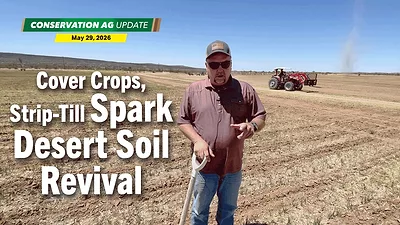
A one-time tillage pass has no adverse effects on yield or soil properties on no-till land, according to field research conducted at the University of Nebraska-Lincoln.
Although tillage is another expense for farmers and generally increases the risk of soil erosion, a one-time tillage pass may be performed to correct some problem, such as a perennial weed problem.
The feasibility study was conducted for 5 years at two locations in eastern Nebraska. Charles Wortmann led the interdisciplinary team in examining the effects of a one-time tillage pass on no-till land for grain yield, reducing stratification of soil properties, increasing soil organic matter and improving soil physical properties. The results were published in the July-August 2010 edition of Agronomy Journal.
The report says that continuous no-till crop production has been widely adopted for reduced fuel consumption and labor requirement, erosion control, improved surface soil properties, increased profitability and often increased yield.
Crop yields have generally increased in the western and southern parts of the U.S., although northern agricultural lands have seen some declines in yield. Nebraska occupies a transition zone, with little change in yield due to no-till.
The researchers were testing whether one-time tillage of no-till could help manage certain perennial weeds, and reduce phosphorus stratification and runoff. They also wanted to determine if a one-time tillage pass — by burying the enriched surface soil and bringing deeper, less improved soil to the surface — improved soil structure and the distribution of soil nutrients.
Tillage did reduce stratification of phosphorus, soil organic matter and soil bulk density for the first years, but by the end of the 5-year experiment, there was no difference between one-time tillage and no-till treatments.
One-time tillage had no effect on soil organic matter content in the surface 1 foot of soil after 5 years. One possible negative effect of tillage was reduced microbial biomass at one site, but it did not affect grain yield.
The study areas consisted of one plot of grain sorghum rotated with soybeans and corn with soybean at the other location. Tillage treatments included deep plowing with moldboard plows or a mini-moldboard plow, and disc tillage. The tillage was done in late fall or very early spring to have low soil temperature and microbial biomass preceding and following tillage to minimize soil organic matter losses.
The authors concluded that one-time tillage of no-till can be done in eastern Nebraska without measurable long-term effects on yield or soil properties, except for a change in soil microbial communities. Since tilling increases erosion risk, the authors recommend tilling only to address problems that cannot be cost-effectively managed with no-till.
The full article is available for no charge for 30 days.